Editor’s note: Eli Dean is the author of this report.
As poverty rates in Arkansas continue to be above the norm seen throughout the country, Prairie County isn’t alone in citizens needing extra help during the summer months. This time of year is especially daunting to those needing food, and one local church has been working for over ten years in Hazen to provide for those who need assistance.
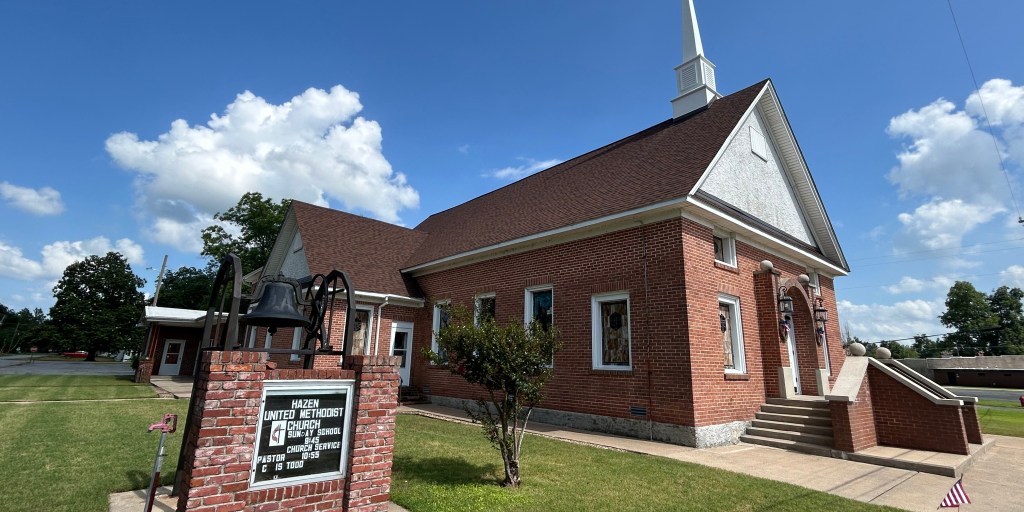
Hazen First United Methodist Church, led by Rev. Dr. Chris Todd, is home to the only food bank in Prairie County that partners with the United States Department of Agriculture (USDA). Every fourth Thursday of the month, citizens who show proof of living in the county are welcome to come to the church and pick up a box of food products meant to help ease their burden over the next month. Todd said that from the start of the church food bank, the goal was to help the community.
“For Hazen and the county proper, poverty is very high,” Todd said. “Food insecurity is a real problem, and so about ten years ago, the church decided that we’re going to do something about it.”
Findings from the U.S. Census Bureau last year that looked at the entire 2024 year indicated that about 15.5% of Arkansas citizens live below the poverty line, which is roughly 466,000 people. That ranked as the fifth worst among all states.
However, according to that same U.S. Census Bureau research, Arkansas poverty rates are on the decline. The 2024 rate was the lowest since 2010, when the poverty rate was 18.8%. Todd said that the church’s mission is to be a part of the solution in the hopes of one day eradicating poverty in the state.
“I would love to get to a point where we are serving zero, because that means we’ve addressed food poverty and insecurity in the county,” Todd said. ‘But that’s unrealistic, and so we want people to show up. If you’re hungry, we’re going to feed you.”
On average, Todd said that around 50 to 75 families are fed each month using their program. He encourages families to show up if they need it, hoping to break the stigma that needing help is a bad thing.
“There’s no judgment here,” Todd said. “Just come in, we don’t ask questions, it is all about getting the message out and saying ‘you are welcome in this place.’ We have to do a better job helping people realize it’s not a problem to ask for help.”
According to research published by the Annie E. Casey Foundation, the cost of child poverty every year in the U.S. as a whole has reached a trillion dollars, and the summer months don’t make it easier when schools are closed and children aren’t guaranteed a meal five days a week. Todd said that for the next few months, that is something the church is taking a closer look at as they try to assist families the best they can.
“That is something that we as a church need to look at,” Todd said. “How can we bridge that divide? I don’t know if there’s anything in the county right now that offers our kids lunch and breakfast, so that’s something we are going to be looking at.”
Another factor that makes things difficult for food banks and the people who participate in the program is recent legislation from the federal government that will likely reduce the amount of help people can receive, as well as make it harder for the programs to assist those who need it. In a statement by the Arkansas Advocates for Children and Families, the passing of the One Big Beautiful Bill Act (H.R. 1) will soon hamper states like Arkansas by reducing the amount of federal funding given to the Supplemental Nutrition Assistance Program, better known as SNAP. As a result, “states must absorb these federal cost shifts to continue operating this critical food assistance program that helps families, veterans, and people with disabilities purchase groceries.”
Previously, the individual state and federal government shared the responsibility, but with the passing of H.R. 1, it now means that states have 75% of the responsibility, and many states are scrambling to meet that added cost. Recently, however, state lawmakers in Arkansas during the 2026 fiscal session did not approve the additional funding, estimated by The Arkansas Advocate a news organization that claims on their website to be “independent” and “nonpartisan,” to be $24 million, which means the money needed to keep funding the program will need to be found elsewhere before Oct. 1, when the state will be on the hook for the additional 25% of funding.
Changes to the program are also expected sooner. Starting July 1, Arkansas will ban the use of SNAP funds for several types of foods and liquids, which include sodas and highly processed foods. With all of the extra legislation soon to play a big factor in Prairie County, Todd said that while the church hasn’t been too affected so far, it might soon make its job more difficult. He said that when that time comes, his church will be ready to respond.
“Legislation doesn’t help when it targets underserved communities,” Todd said. “Luckily, there are places like this church that will step in and fill that gap for those who need.”
As the rest of the state anxiously turns its calendars to another month closer to October, local communities across Arkansas are preparing to help lessen the looming threat. More information about Hazen First United Methodist Church and its food bank can be found on its Facebook page, and any updates to the program, as well as ways to donate, can be found there.
Todd said that anytime those who need help stop by the church and ask, he and his staff are ready to help.
“Since I’ve been here, we’ve never run out of food,” Todd said. “Which I think is a blessing and a curse. If we’re not running out of food, we probably could give more out. But we also hold some back, as we get more people coming in. People will come by during the week, they need a box and knock on the door, and there you go.”