
No insurance, no problem.
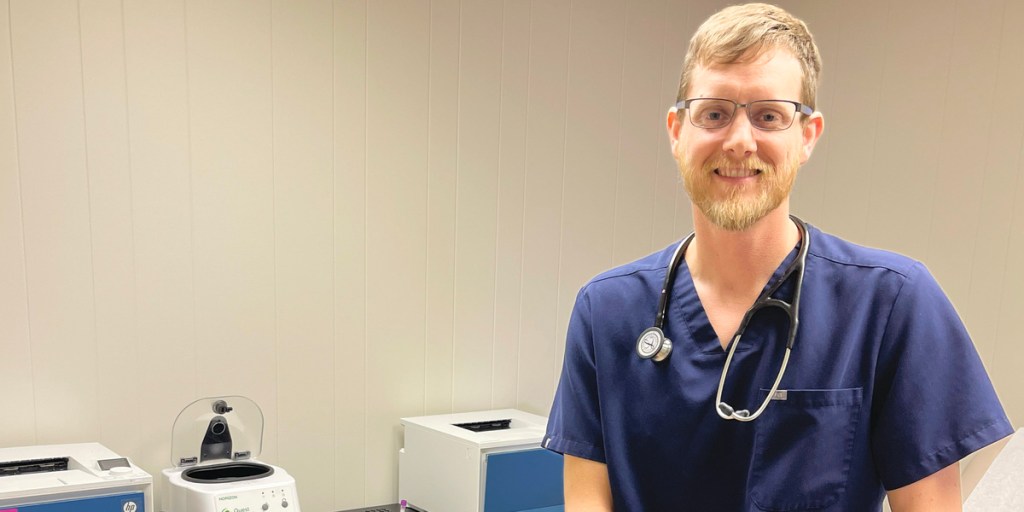
Dr. Matthew Wagner and his wife, Anna, a registered nurse, are testing a relatively new model of rural health care in Carlisle.
Grand Prairie Health is a membership-based healthcare operation where participants pay a flat monthly fee, based on age range, and get direct access to a primary care physician for service and limited diagnostic testing. The clinic is across the street from the Carlisle Post Office on North Court Avenue.
The Wagners are natives of Carlisle and graduated from high school locally before pursuing their medical degrees and returning. Matthew worked in clinical settings during residency and delivered babies before serving as a hospitalist at a major hospital system. A hospitalist typically provides a broad range of consultation and is knowledgeable about a lot of comprehensive care practices.
Matthew Wagner prefers the personal touch of getting to know his patients, communicating with them frequently in-between visits, and finding more affordable solutions for folks in the region. He said he opted to form Grand Prairie Health instead of associating with a smaller, rural-based clinic.
“Just from my style, when I talked to them [other clinics], they were like the minimum expectations were to see 25 patients a day,” he said. “If you see all these other ones, then your pay is a little bit more and a little bit more. But what that translates to is you can’t give substantially more time with the patient.”
Competitor clinics are often considered “safety net” clinics and they see patients that are low income enough to qualify for Medicaid or Medicare. Wagner says the level of care at those facilities is good. His target demographic is typically a patient that doesn’t qualify for Medicaid, doesn’t have insurance, but also doesn’t have a ton of need for frequent medical attention.
“A big portion of our population is people that don’t have insurance, but they say, ‘Hey, I can spend $40 a month on my child.’ So the person that I’m about to see in a little bit, I’ve seen them a few days ago, and then I’ve texted them nonstop since then. All of that care – those three encounters I’ve talked to them – the whole month is $40. So if they see me five more times this month, there’s no extra they have to pay,” he explained.
The business model works like this:
You don’t need insurance – as a matter of fact, Grand Prairie Health doesn’t take it. You pay a monthly membership fee. For anyone ages 0-20, you pay a flat $40 a month; for ages 20-40, the fee is $60 a month; for ages 40-60, it’s $75 a month; and ages 60-plus the fee is $90 a month. While you must pay the monthly fee, whether you use the service or not, the flat rate is dependable for budgeting and considerably less than some health insurance options.
“So anyone that has $90 cash, that’s really who I envision as most likely to come to us,” he said. “I think it’s a cost savings.”
There are three large pools of potential patients that meet the target demographic for the Wagners’ clinic. They are people who have no insurance and struggle to qualify for it; employers who may not be able to provide a health insurance plan for their workers, but could pay the monthly membership fee or a portion of it; and retirees looking for a flat, consistent cost option.
“A retiree may have enough in their savings where they’re like, ‘Man, I would love to just pay $1,000 a year, more or less, and never have to sit in the waiting room for the rest of my life.’ They just want the luxury of being able to text their doctor anytime,” said Wagner.
For employers, such as farmers who have hired crews, but can’t afford a health insurance plan, Wagner may be an alternative that works.
“A farmer that can’t offer health insurance to his employees, but they can offer unlimited primary care. We don’t charge anything for [simple] procedures,” he said.
The clinic does pass through some costs of testing or supplies, but the costs are pretty much wholesale and not marked up like one might see in a hospital system that is mandated by insurance regulations to charge a certain fee or price that’s contractual.
Wagner describes an experience his father recently had where he needed stitches in his hand. He waited in the emergency room at a hospital and was ultimately charged $3,500. Insurance paid half of it and his father had to pay the other half. With the flat monthly fee at Grand Prairie Health, that procedure could cost nothing.
“I had another person the other day on the farm, I had to do a procedure on their finger and there was no extra cost,” he said.
Wagner earned his medical degree at UAMS and completed his residency at Via Christi Family Medicine in Wichita, Kansas. He’s been seeing patients of all varieties for more than a decade. His wife, Anna, earned her nursing prerequisites at Arkansas State University and completed her education at Butler Community College and Fort Hays State University in Kansas.
When Matthew was serving as a hospitalist, his beliefs for the business model of Grand Prairie Health were reinforced. He would often see patients who could have prevented a hospital stay by seeing their primary care physicians early on.
Often, he discovered that patients would declare insurance was too much of a hassle or the amount of time to wait for an appointment was too delayed. Wagner offers unlimited and personal service.
“We do a ton of emails and texts because the patient prefers it, but now you don’t have to get them in to be compensated for that,” he said. “It’s just better care, I believe, because every one of my patients has my direct cell phone number.”
“The first time I see someone, it’s an hour… We opened October 1st. No one that I’ve seen has had to ever wait in the waiting room. I usually meet them at the front door and walk them back. So it’s just a very nice experience,” he added.


 The Grand Prairie Herald